

You closed the week strong. Trucks moved. Shelves emptied faster than usual. Your sales reps came back with fresh orders, and the shop was busy from Monday to Saturday.
Then Friday came, and you couldn’t pay a supplier invoice on time.
If that sounds familiar, you are not doing anything wrong — and you are not alone. It is a recurring problem for growing distributors: the business looks busy, sales figures look good, and yet the cash to run it never seems to be there when it’s needed.
Why Sales Are Up But Your Cash Isn’t
“The shop was busy all week. Where did the money go?”
That question sits at the center of a lot of sleepless nights for distributors across Emene, Abakpa, and the wider Enugu commercial districts. It doesn’t make sense on the surface — sales are up, so shouldn’t cash be up too? But sales and cash are two different things, and the gap between them is exactly where a distributor’s capital quietly disappears.
Here’s the part that matters most: this is not a math problem. It’s a visibility problem.
Where the Cash Actually Goes: Five Places to Check
Rising sales and shrinking cash isn’t one problem — it’s usually several small ones happening at the same time, in different corners of the business. Before you can fix anything, it helps to know which of these are actually at play in your business:
Credit sales. The sale is recorded the moment it happens, but the cash hasn’t arrived yet — sometimes for weeks. Sales go up on paper immediately; cash follows later, if at all.
Sales-rep collections. Money has already been collected from a customer, but it’s sitting with the rep, not yet banked or reconciled against what was actually sold.
Supplier commitments. Cash may be sitting in the account, but it’s already spoken for — earmarked for a payment due this week or next.
Stock replacement. Growing sales often mean you need to buy more stock sooner, which pulls cash back out of the business almost as fast as it comes in.
Unexplained differences. After accounting for the four items above, whatever is still missing deserves a closer look — it may be a recording error, a timing issue, or something that needs further investigation.
It is easy to treat the problem as one cash shortage when several different things may be happening at once — which is exactly what the check below is designed to separate out.
What a Cash Flow Gap Actually Threatens
When cash and sales stop matching up, the damage isn’t only financial.
You can’t restock your fastest-moving product, even in a “good” month, because the cash from those sales isn’t actually sitting in your account — it’s still out with a customer, or a sales rep, or committed to a supplier payment you forgot was due.
You start looking at your own staff differently. Without a clear number to point to, it’s easy to suspect leakage, theft, or carelessness — sometimes fairly, sometimes not. Either way, trust in the business starts to erode.
It shows up in front of people you don’t want it to. A supplier calls about a late payment while a staff member or a customer is standing right there. You have to explain, at home, why a “good month” didn’t produce the money everyone expected.
None of this happens because you’re bad at business. It happens because sales reports and cash reports are usually two separate conversations in a growing distribution business — and nobody is checking them against each other daily.
A Two-Week Cash Flow Check You Can Do Without Software
Before anything else, try this. It takes about fifteen minutes a day for two weeks, and it’s built to test the five items above one at a time.
First, work out your cash position — what you actually have access to right now:
Start with your bank and hand cash balance.
Add cash currently held by sales reps or in transit — money that has already been collected but not yet banked (mechanism 2). This is still business cash; it just hasn’t reached the bank yet, so it belongs on the “available” side once you’ve verified it against what each rep actually collected.
Subtract every supplier payment due in the next 14 days (mechanism 3).
Subtract your estimated cash required for essential stock replenishment this month (mechanism 4) — this is an anticipated requirement, not a fixed commitment like an invoice already due, so treat it as an estimate.
That gives you an estimate of cash available after your near-term commitments.
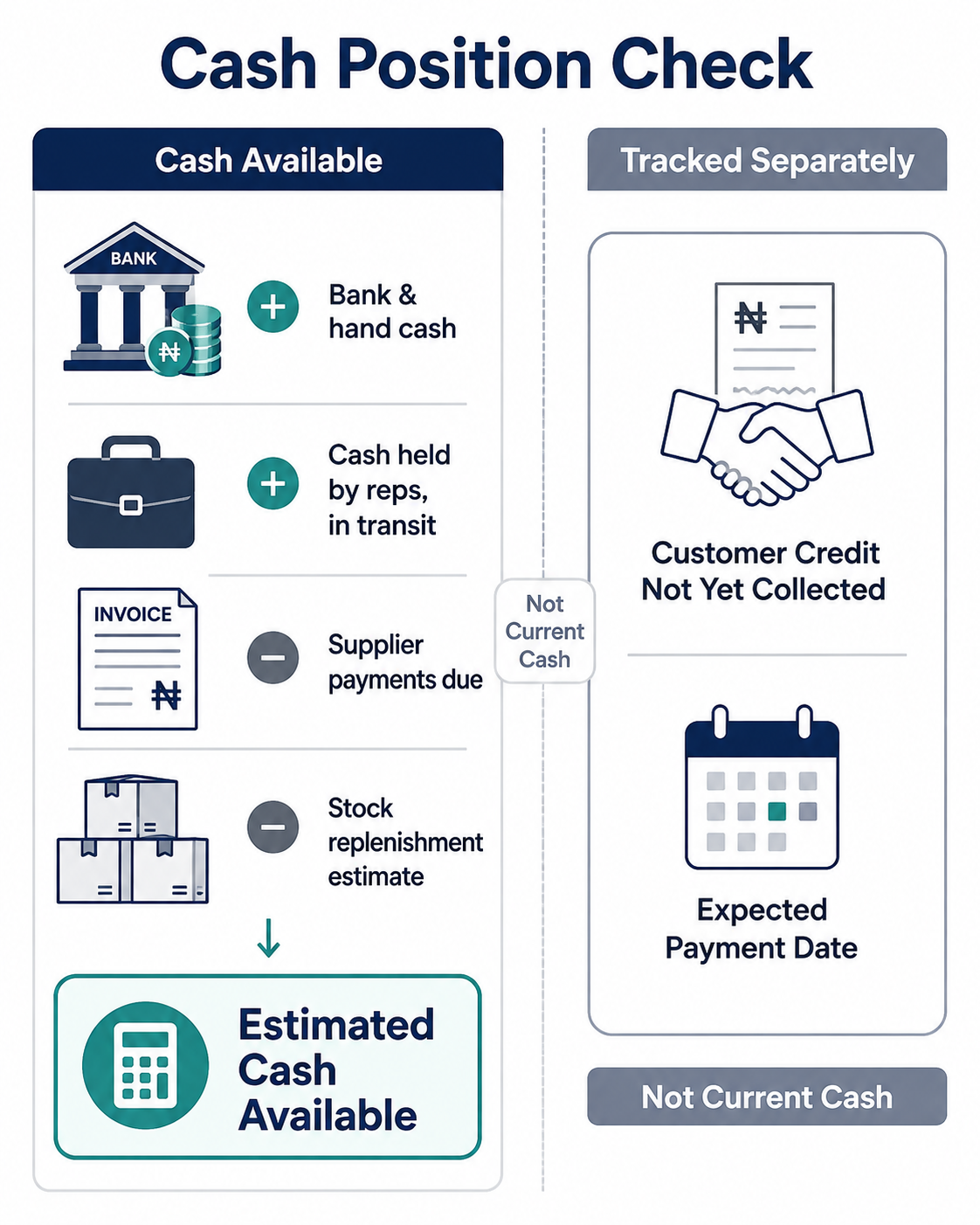
Second, track receivables separately — this is not current cash:
List everything sold on credit this month that hasn’t been collected yet (mechanism 1), with the amount and the date each customer promised to pay. This money may arrive later, but it isn’t available to you now, so keep it out of the calculation above.
If the resulting amount from the first calculation is negative, that doesn’t by itself tell you why — it means your near-term commitments exceed the cash you’ve identified as available. This calculation tells you your near-term cash position; the supporting records — your receivables list and rep-collection log — tell you why that position looks the way it does. That’s where you go to see whether the pressure is a timing problem (money is coming, just not yet) or something that needs closer investigation (mechanism 5).
What Actually Fixes a Distributor’s Cash Flow Problem
This is not a case for buying a big new system immediately. Before any software conversation, three habits can improve visibility into the five items above:
Reconcile cash daily, not just sales. A daily sales total tells you what left the shelf. It does not tell you what’s actually in the bank. Track both, side by side.
Keep one clean, shared record of who owes what and by when. It doesn’t need to be complicated — it needs to be checked every single day, by someone who is accountable for it.
Separate “sales performance” from “cash position” as two different reports. They answer two different questions, and a business only stays healthy when both are being watched.
These habits give you a clearer record against which to examine the five mechanisms and decide what needs closer attention. That can also give you a better basis for deciding whether a bigger system is necessary and where it would add the most value.
What This Looks Like in Practice (An Enugu Example)
The following is a simulated example, with illustrative figures, based on common patterns seen among Enugu distributors. It is not a specific client result.
Picture a distributor running three sales reps across two product lines, with sales growing steadily month over month. Working through the calculation above for one month might look something like this:
Bank and hand cash: ₦2,000,000
Plus cash held by reps, not yet banked: ₦500,000
Minus supplier payments due in 14 days: ₦800,000
Less estimated cash required for essential stock replenishment: ₦400,000
Estimated cash available after commitments: ₦1,300,000
Separately, the receivables list shows ₦600,000 in customer credit not yet collected — money that may arrive over the coming weeks, but wasn’t part of the calculation above.
None of this means anything was stolen or lost. It means the ₦2,000,000 sitting in the bank looked like more breathing room than the business actually had, once rep collections were verified and near-term commitments were accounted for — and it separates that from the ₦600,000 still owed by customers, which is a different issue that may require a different response.
The two figures point to different questions: how much cash is available now, and how much money is still tied up in customer credit.
Try This Before You Decide Anything
Run the two-week check above on your own business. It costs you nothing but a notebook and fifteen minutes a day.
The exercise may help you identify which area needs closer attention. But if you finish it and still have unexplained differences, records scattered across reps and notebooks, or uncertainty about which of the five items is really the problem, that is a reasonable point to consider a structured outside review rather than continuing to work from incomplete records.
That’s what a Distributor Cash-and-Stock Diagnostic — the entry point into DGIT Advisory Essential — is built for: a fixed-fee review covering a stock-flow review, a receivables review, a supplier review, a leakage-risk report, and a recommended dashboard, so you know what to fix before committing to anything larger.
Book a Distributor Cash-and-Stock Diagnostic